Sunday, 16 March 2014

Social Media and the World Leaders/ Presidents


When we talk about social media and work place, we are not talking only about a pacific size company or enerprize. But  workers in any work place any size such as a small home office a  medium size office  or a big organization with channels all over the world, they  all have policies and they all experience changes in the way work is conducted from past to present. Most of the changes are here as a result of the emergence of new technology and new social media.
In my previous blogs I already talked about the use of social media and the changes it has brought to organizations and what employers and employees should consider when they use social media at work place. Here I want to think big and talk about the importance of social medial in a much bigger and crucial workplace which is the presidency and leadership or conducting a whole country and working for the people of the whole country.
If running an organization can benefit the use of social media, for sure running a country also needs use of social media and can benefit from it in different aspects and different ways.
 Traditional media has lost its popularity and use it once had in terms of campaigns and public relations. The new  outlets of social  media have  created a two way active connection between the two sides of senders  and receivers  and it is no longer a one way media as it was in past when people had TV or radio to listen to and to be connected to the world. It is now a two way conversation tool. People get the chance to read and comment and send their message and their voice to the other side.
 Using social media is beneficial for any job in any field. Leading a country is not an easy job and that is why I thought if I am talking about organizations and CEOs and managers using social media at work place, it is good to talk about the use of social media in presidential elections

In traditional campaigns TV, radio, newspapers, advertisement and mail had big role in presidential elections. The presidents and leaders advertised their positions, gave speeches, and went to different towns to talk to people and the reports for all these were sent to people through the basic social media outlets that we mentioned. But today things are very different. Today candidates are expected to know the use of social media outlets such as face book, twitter, blog, text messaging and many others to reach targeted audience and to be connected to public and to increase the rate of participation among different age groups from different distances. Use of social media for presidential campaigns is a very effective and efficient way saving time and money for both sides for voters and for the parties. Making advertisements and to pay for TV or radio air time for broadcasting the campaigns have been very costly. However, today even though these advertisements are still part of a campaign and awareness programs. There are so many other types of social media that facilitates the process and saves money.
People of different age can take part in the elections and be updated about the news anytime and anywhere they are.
TheNew York Times on its Media and Advertisement page published an article about the power of social networks in presidential campaigns. I found the following paragraph interesting to share here in my blog. 
“Thomas Jefferson used newspapers to win the presidency, F.D.R. used radio to change the way he governed, J.F.K. was the first president to understand television, and Howard Dean saw the value of the Web for raising money.  But Barack Obama understood that you could use the Web to lower the cost of building a political brand, create a sense of connection and engagement, and dispense with the command and control method of governing to allow people to self-organize to do the work.” (The New York Times)


https://encrypted-tbn1.gstatic.com/images?q=tbn:ANd9GcS7ZUo7ev-AkJNw9sPJszendgugIkl31xRNy3YABFKR3Ig9Tl4t
Looking at all these changes social media has brought to different aspects of work and life, we can predict how things are going to be in future with the way social media is growing.
 According  to MATTHIAS LÜFKENS from the Atlantic “In the near future, no one will be able to become a leader without digital followers, and no diplomat will be well-positioned to represent his or her country if he or she does not personally engage on social networks. And it is not the size of the followership that matters, but the quality of the conversations.  (MATTHIAS LÜFKENS, 2012)
Here is a you tube video from Good Day New York talking about Social media's impact on the presidential election.

http://www.youtube.com/watch?v=7iqsthA2Jbg

How can social media help leaders of a country
·         Build awareness
·         Build a personal brand
·         Helps with presidency campaigns
·         Create a sense of engagement and connection with public
·         Get connected to public  in different parts of the country in real time
·         Lower the cost of campaigns
·         An opportunity for citizen feedback and deliberation
·         Gather a big pool of ideas on candidates and policies that would otherwise have been hard to get
·         Efficiently  and effectively gather ideas, get advice, convince and persuade people


http://cribsuite.com/news/wp-content/uploads/2013/09/Screen-Shot-2013-09-06-at-11.21.14-AM.png


Do presidents of the different countries use social media?
As I mentioned earlier, today the leaders and presidents of different countries use social media not only for their presidential campaigns but also for different other purposes on daily basis.
Here are some interesting facts about a few presidents out of the many presidents that use social media. 

1    1- Barak Obama and social media- Based on some data gathered from (twitaholic .com and twitter counter.com) “as of June 12, 2012, Obama's account had 16,505,044 followers, followed with 677,188 accounts and had posted 4,239 tweets. Well into 2011, it was following the most people of any account on the network and was the third to achieve ten million followers. It is one of only two accounts in the world to be in the top ten in both followers and followees. As of June 12, 2012, the White House account is also among the two-hundred most followed with nearly three million followers. (Wikipedia)
2- Latin American presidents have taken to tweeting with gusto. Seven of the 25 most-followed world leaders hail from the region, according to Twiplomacy, a website. Among the most active is Argentina’s Cristina Fernández. She frequently tweets out verbose diatribes split across dozens of messages; she once tweeted 34 times in 32 minutes. Although she has over 2m followers, she herself follows only 54, with not a single non-Latin American leader among them” (The Economist, 2013).
      3- “Hugo Chávez was second only to Mr Obama as the most-followed leader before his death earlier this year. He has been replaced as the Twitteratus maximus of Latin America by the Argentine Pope Francis, who has 4m followers of his Spanish- and Portuguese-language account”. (Follow the leader, 2013)
       4-   Venezuelan President Hugo Chavez used Twitter to rally his 3.6 million followers and secure re-election on October 7, 2012.
    5- “Twiplomacy study found that;

  •          E.U. President Herman van Rompuy (@euHvR) is the best-connected world leader, mutually following 11 peer
  •            Australia's prime minister (@JuliaGillard) is the second-best-connected leader, with 10 mutual connections, followed by the Korean presidency (@BlueHouseKorea), the U.K. government ( @Number10gov), and the Russian prime minister (@MedvedevRussia), all of whom follow (and are followed by) nine other world leaders”. (Twiplomacy study , 2012)

Bibliography

(n.d.). Retrieved from http://www.economist.com/news/americas/21583263-how-presidents-tweet-follow-leader
(MATTHIAS LÜFKENS, 2012). Retrieved from http://www.theatlantic.com/international/archive/2012/10/tweet-me-to-your-leader-how-the-worlds-big-shots-use-social-media/263752/
(n.d.). Retrieved from Wikipedia: http://en.wikipedia.org/wiki/Barack_Obama_on_social_media
 (Follow the leader) (2013, Aug 10). Retrieved from Follow the leader: http://www.economist.com/news/americas/21583263-how-presidents-tweet-follow-leader
The New York Times. (n.d.). Retrieved from http://www.nytimes.com/2008/11/10/business/media/10carr.html?_r=0
Twiplomacy study 2012. (2012). Retrieved from Twiplomacy: http://twiplomacy.com/twiplomacy-study-2012/


The Impact of Social Media on Postal Services


The mainstream use of social media for communications has had a big impact on postal services and mailing system and on the employment of the people who work there.


http://superiorprintingcentre.com/wp-content/uploads/2013/03/BlogPostMar05-13.jpg  (superiorprintingcentre.com)
In past mailing was the only way through which people sent each other messages.  People also used mailing services to send their payments and to receive their monthly statements and their bills. Even though It was time consuming and had some cost involved in it, it was still used very widely. There weren’t any of the social media outlets that we have now for communications . Therefore, postal services were in demand and were in good economic conditions.
One of the first mediums of social media that came to use and had a big negative impact on posting system was email. People started using email for work and for personal communications. In past most of the communications at workplace between different offices and organizations took place via mail. The number of mails sent out on daily basis was much bigger compared to the ones sent out now. Here is the link to a site showing the progress of email. (Josh Wolford, 2011)

  It is true that mail and courier services still have some use at workplace and still are considered good ways of sending documents. However, for the purpose of fast decision making and quick communications, email is used more than mail now.
http://www.marketingtango.com/wp-content/uploads/2012/10/directmail-or-email-both.jpg (Email vs Mail)

Email is no longer the only type of social medium that affected posting system. There are so many other social media outlets such as instant messaging, blogs, Face book, twitter and many others that are used at different work places today and are replacing mail.
Sending a message in real world is so much different from sending a message to someone in virtual world. We use mailing system to send a letter to people whom we know or to people we do business with. If we ever receive a letter from someone whom we do not know and the letter updated us on the status of a total stranger sender, we would definitely find that very odd and irrelevant. While now if we see a post on a social networking site about someone whom we do not even know, we still take interest and read it and most of the time we even comment on their post and write them back.

Posting system has experienced some changes due to the evolution of social media and its use. Some of the changes are change of 7 day service to 5 day service, Canada post ending door to door delivery in urban areas and some other cut backs.


http://www.nzpost.co.nz/sites/default/files/uploads/shared/images/mail-volumes.jpg (NZ posts)

National post published an article on Canada post and its cut services on December 11, 2013 where we can see some data about changes Canada post brought in the last few years. Here are a few facts from that publication copied here. (Hill, Lee Berthiaume and Andrea, 2013).
·         2000: Post Office launches ePost, a digital mailbox for bills.
·         2007: First decline in domestic lettermail delivered in Canada
·         2012: Canada Post notes decrease of one billion pieces of lettermail compared to 2006.
·         2013: Canada Post begins charging developers $200 per address for the set up of community mail boxes in new neighbourhoods


Well, looking at these  cut backs and changes,  we can imagine how they must have affected the workers who work for postal services. A lot of layoffs and cut backs, salary issues and  other financial issues  for workers at postal services. The post office services and their economic issues are seen in most of the countries around the world.  Here is a youtube video on “Social media reacts to Post Office Announcement in the States” 

http://www.youtube.com/watch?v=7Mi2Wuimva4 (WP TV News Channel 5)

However, social media has brought some good changes to postal services as well. Postal services use more social media to better communicate with customers, other businesses as well as with stake holders.

In summary, social media has had big impact on different types of work places. The impact has mostly been positive. However, postal system is one of the work places that has experienced the negative impact of social media more than its positive impact.

Bibliography

 (Email vs Mail) Retrieved from http://www.marketingtango.com/wp-content/uploads/2012/10/directmail-or-email-both.jpg
Hill, Lee Berthiaume and Andrea. (2013, December 11). Canadian Politics. Retrieved from National post: http://news.nationalpost.com/2013/12/11/lisa-raitt-defends-canada-post-cuts-as-modernizing-while-olivia-chow-decries-government-destroying-mail-services/
 (superiorprintingcentre.com). Retrieved from https://encrypted-tbn2.gstatic.com/images?q=tbn:ANd9GcTTeOP4e8LjIyLcaCTIjWWyN9gyFCK9rjVFTrvtM6dAXs1Z8XU1tQ
Josh Wolford. (2011, May 5). Web Pro News. Retrieved from Social: http://www.webpronews.com/email-social-media-communication-increases-im-use-decreases-2011-05
mail Vs email image. (n.d.). Retrieved from http://www.marketingtango.com/wp-content/uploads/2012/10/directmail-or-email-both.jpg
NZ posts. (n.d.). Retrieved from http://www.nzpost.co.nz/sites/default/files/uploads/shared/images/mail-volumes.jpg
WP TV News Channel 5. (n.d.). Retrieved from http://www.youtube.com/watch?v=7Mi2Wuimva4

Sunday, 2 March 2014

Social Media & Work Place Policies

 In my first blog I already discussed the importance of social media at workplace and its use interdepartmentally and globally.  Here in my second blog I want to talk about the consequences of using social media at work place and what should both employers and employees know about the use of social media at work place.
http://images.fastcompany.com/upload/navigate.jpg(fast company)
During different time periods from past to present and  in the future employers have always had some responsibilities to assure the implementation of  all rules and regulations on labour laws, employment discrimination laws, employees’ rights, vacations laws and many other laws that exist in regards to employment. An employer always has to make sure that the employees work in a safe and secure environment free from bias, discrimination, assault and any unethical actions.   The only difference an employer would experience from past to present is that in past the concern was more on issues happening in real world while now there is the addition of issues in virtual world and  use of so many different channels of social media. Today use of social media especially at workplace does not only have pros that I already discussed in my first blog, but it also has some cons such as decreased productivity, unwanted and sometimes excessive publicity, release of confidential information, discriminatory posts, unethical use of work time and work devices for personal communications, and many other legal claims and issues related to use of social media at work place.
According to research from Silk Road; “75 Percent of employees access social media from personal mobile devices at work (silkroad news and media)
Here is a you tube video from Work span TV on “Social Media in the Workplace: Legal, Policy and Productivity” (workspan TV)
http://www.youtube.com/watch?v=uLG9jwgAios( WorkSpan TV)
Today with the fast growth of social media and its users, so many unique and different legal cases come up every day.  Legal system and courts face many new cases on use of social media at work place. Making decision on those cases is not very easy even though courts keep consulting electronic communication laws such as communications and telecommunications Act.
Accessiblity of social media everywhere including work place makes it easier for many workers who are having a bad day at work to make inconsiderate and spontaneous postings and comments and create issues for themselves and for their employers.

http://marketingstrategyexpert.files.wordpress.com/2012/10/facebook-cartoon-7.gif?w=300&h=222(Marketers blog)

 Daily news on newspapers and websites are full of stories related to employees’ use of social media and its legal consequences.
 On Aug 2011Mcmillanpublished an interesting news on its "employment and labour bulletin" that was as follows;
“Two employees employed by West Coast Mazda, an automotive detailing and accessory shop in Pitt Meadows, B.C., were terminated as a result of a series of Facebook postings described as "offensive, insulting and disrespectful." Both employees were strong supporters of a union drive, and both were Facebook friends with a manager at the company. The manager was disturbed to find that the employees' Facebook postings targeted management, the business and the products sold by the business. The employer conducted an investigation and met with each employee. In the meetings, the employees were provided copies of their Facebook postings. Both employees denied making the postings. Following the meetings, both employees were terminated”  (George Waggott, 2011)
Well, knowing that social media at workplace can be useful as well as harmful, then what should employers and employers know about the use of social media to make them cautious and inform them of the right use of social media at work place.
Here are two awareness point sheets one for employer and employee each on use of social media at workplace;

 Employers' To Do,  in regareds to employees’ use of social media at work place
  •       Have a clear policy and guideline on use of social media at work. In the policy clarify the terms of service and use of social media and the legal consequences related to misuse of social media
  •  Educate  employees to use social media within rules and regulations , especially  when staff is allowed   to use their own devices at work
  •    Ensure the employees are familiar with privacy and confidentiality policies.  
  •    Review and update employees regularly on following the recent rules and knowing the legal consequences.
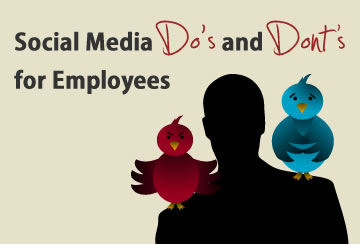
http://www.klugerkaplan.com/blog/wp-content/uploads/2013/01/dos-and-donts-for-employees.jpg (google images)

Employees' To Do,  in regards to use of social media at work place
  •       Make yourself familiar with privacy, confidentiality and use of social media policies.
  •           Always be aware that any posts you make from work, your company can see that
  •           Do not post something that you would not want your boss or police to see it because chances are that they might see your post very soon
  •          Do not post any personal information or comments on employer or other employees
  •          Make sure to keep  personal and professional communications separate at work place
  •           Do not use social media to harass, intimidate, or bully other employees.
  •          Use social media respectfully and effectively
  •          Use social media within the rules and regulations of your employer
Watch this YouTube video on “Social Media and the Workplace” (Common Craft)  that talks about the power and the responsiblities of Social media for organizations and for employees.

In summary, having clear work place rules on the use of social media is very vital both in present and future times when we are dealing with many new technology and social media outlets at  work place.
Clear rules and policies can protect the employers from legal claims and extra costs and help them maintain a positive work environment. And for employees abiding by the workplace rules on use of social media is one of the factors in maintaining job security and productivity at work place. And it is vital for any period of time in present and future when we have to deal with use of many new technology and social media outlets.

Well, the best is to have fun with a safe use of social media. Here at the end of this blog we,for sure,  want to have some fun after all this serious talk about the consequences and legal issues of improper use of social media at work place. So let's read some jokes on social media and have some laugh.
I will come with new topics on social media at work place in my next blogs. So check back here for new blogs on social media & work place. 

https://encrypted-tbn3.gstatic.com/images?q=tbn:ANd9GcQ1D0Ex9oheMlc44aorN7fXrX0mAmbDqH_KL9PqfNOwgW07gg4I (community relations)


      Social media jokes (Facebook jokes, 2014)

  •         20 years ago we had Johnny Cash, Bob Hope and Steve Jobs. Now we have no Cash, no Hope and no Jobs. 
  •        Q: What happened after Miss New Jersey, Amy Polumbo, lost her crown due to racy pics being leaked from her Facebook Account?
     A: Amy Polumbo received a million friend requests! 
  •       "Dammit im mad" Back-Wards is still "DAMMIT IM MAD!" 
  •          I'm going to change my name on Facebook to 'Benefits', so that when you add me, it will say, "You are now friends with benefits." 
  •        In a recent interview Facebook CEO Mark Zuckerberg stated, "The only meat I'm eating is from things I've killed myself." It was reported that for lunch this afternoon he ate "Tom" from MySpace
  •             Oh Grandma! A dying grandma tells her grandchild, "I want to leave you my farm. That includes the barn, livestock, the harvest, the tractor, and other equipment, the farmhouse and $24,548,750.45 in cash." The grandchild absolutely floored and about to become rich says, "Oh grandma, you are SO generous! I didn't even know you had a farm. Where is it?" With her last breath, Grandma whispered, "Facebook..."

Bibliography


(silkroad news and media). Retrieved from silk Road: http://www.silkroad.com/Company/News-and-Media/Press_Releases/2012/10/Social_Survey_Report_Press_Release.html
(fast company). Retrieved from Amzon.com: http://images.fastcompany.com/upload/navigate.jpg
Common Craft. (n.d.). Retrieved from You tube.com: http://www.youtube.com/watch?v=Sfs5P3VN0Ho
Community relations. (n.d.). Retrieved from Devianart: https://encrypted-tbn3.gstatic.com/images?q=tbn:ANd9GcQ1D0Ex9oheMlc44aorN7fXrX0mAmbDqH_KL9PqfNOwgW07gg4I
Facebook jokes. (2014). Retrieved from jokes for us.com: http://www.jokes4us.com/miscellaneousjokes/corporatejokes/facebookjokes.html
google images. (n.d.). Retrieved from http://www.klugerkaplan.com/blog/wp-content/uploads/2013/01/dos-and-donts-for-employees.jpg
Marketers blog. (n.d.). Retrieved from Blog Notions:http://marketingstrategyexpert.files.wordpress.com/2012/10/facebook-cartoon-7.gif?w=300&h=222
George Waggott. (2011, Aug). social media policies in the workplace. Retrieved from Mcmillan: http://www.mcmillan.ca/social-media-policies-in-the-workplace
workspan TV. (n.d.). Retrieved from you tube. com: http://www.youtube.com/watch?v=uLG9jwgAios


Sunday, 16 February 2014

Impact of Social Media on Employees based on their Generation


Before diving into impact of social media on employees in the 2020 workplace, let's understanding the various generational categories, and how corporations can communicate effectively with these groups. 

Here are the broad strokes breakdown of the generations by year of birth.


An amalgamation of US and Canadian data sources - Statistics Canada 
(Portrait of generations, using the age pyramid, Canada - 2011, 2013), 
W. J. Schroer (Schroer, 2004) and the classic, Boom Bust & Echo (Foot & Stoffman, 1996)


According to Cam Marston, (author of ‘Motivating The “What’s In It For Me?” Workforce’, and presenter in two YouTube videos (Marston, 2011)), today’s workplace employees belong to one of these four generations – 
  • Mature 
  • Baby Boomer 
  • Gen Xer 
  • Millennial  

Their “attitudes and values are unique to their own generation”. ‘Gen-Flex’ allows management to “operate in the other generations’ world”, as it is important to be able to communicate with each of the generations in the manner that they would like. 

Here are some key pointers, from the videos, to management on understanding and interacting successfully with each generation.


Mature
Learn more about the Matures’ "strengths". They have "institutional wisdom" and make good mentors, so "ask them questions and really listen" to what they have to say.  There’s much to gain with personal interaction, provide them with "clear goals & expectations, and be honest, candid", and above all, "show them respect". In turn, Matures would "benefit from technology" and social media training.

Baby Boomers 
They are "motivated by money, recognition, control and promotion". They’re "workaholics" and looking for recognition. "Motivation is their core strength", and requires precise and detailed feedback. "Face time" is important, so "be accessible, be involved" and get them involved.  Boomer’s "love team" based project and require coaching.

Generation X or Gen Xers
Motivating factors for Gen Xers are "bonus, recognition, meeting personal objectives, mentoring and training".  They’re a "skeptic" lot, so give them "reassurance and proof".  Take time to "talk to them and do so frequently". Management should "do as they say, and honour their commitment – walk the talk".  Use simple "clear and direct talk", not a general suggestion. Explain "why a task is to be done"; this motivates them. Gen Xers are "loyal to the person and not the company". Get in on their agenda, "build a relationship and coach them on career goals". "Personal recognition from the boss, with instant feedback and instant gratification", is high on their achievement list. Gen Xers like a "fun workplace", a "team" environment and need to "separate career and life".

Millennials
Gen-flexing with Millennials involve these motivating factors – "mentoring, recognition, time off, training and meeting personal objectives". They’re the "eager" beavers.  "Work is a part of their life; they do not live to work". "Empathize" with this group. "Negotiate" with them to balance work expectations and flexible working hours. It "builds respect" for the manager.  Spend time with them, as they "need to get along with their boss", and "build an honest and caring relationship".  Help them work on "achieving their goals", and assist them with the "planning and structuring of their work".  Their jobs need to be more "interesting, fun and challenging". "For every corrective feedback, give them three compliments". Keep the "energy high" in this cohort. Offer them "multi-tasking projects" which involve "using technology" (and social media). They should be "provided with close supervision and people-skills training". 


So who are these Millennials? Why do the rest of the generations “hate them”?
‘Hate’ is a harsh word, but even though it’s in the title of Scott Hess’ YouTube presentation (Hess, 2011), it’s dealt with humorously and in a light-hearted manner, expressing jealously and envy towards the Millennials. 

He compares the personality traits of Gen Xers with Millennials, in a 21 minute TEDxSF video, that stems from different parenting styles, and accessing their use of technology and social media.  


Scott Hess, Vice President of TRU. TRU Insight is a leader in youth 
(tweens, teens and 20 somethings) research and marketing, and helping 
organizations make meaningful connections with this segment.


Scott Hess became famous as a leading voice of Gen X when he went online to complain about his boss’ comments on his hair style! The major media networks tracked him down for interviews; he became an instant star! 

Surprise! Surprise! "Millennials are getting labelled the same way as Gen Xers, when they’re actually quite different". 


Millennials are "inclusive, tolerant, engaged, have an effect on corporations' environmentally conscious platform, and are social media trend setters". Their "parents are friends and helpers" unlike Gen Xers’ parents who were "authority figures". 

According to Scott Hess, Gen Xers are “slackers, cliquish, judgemental and anti-corporate”, and finally concludes that Millennials are better than Gen Xers!

So what really makes a Millennial tick? Stay tuned for my next blog.

***************


REFERENCES

Portrait of generations, using the age pyramid, Canada - 2011. (2013, January 5). Retrieved from Statistics Canada: https://www12.statcan.gc.ca/census-recensement/2011/as-sa/98-311-x/2011003/fig/fig3_2-2-eng.cfm
Foot, D. K., & Stoffman, D. (1996). Boom Bust & Echo. Toronto: Macfarlane Walter & Ross.
Hess, S. (2011, June 10). Millennials: Who They Are & Why We Hate Them. Retrieved from YouTube: https://www.youtube.com/watch?v=P-enHH-r_FM
Marston, C. (2011, February 3). Managing Four Generations in the Workplace Part 1 & 2.mp4. Motivating The "What's In it For Me?" Workforce. Retrieved from https://www.youtube.com/watch?v=wxDubDgCDa8; https://www.youtube.com/watch?v=qdbawXRutFM
Schroer, W. J. (2004, April 16). Generations X,Y, Z and the Others . Retrieved from WJSchroer: http://www.socialmarketing.org/newsletter/features/generation3.htm


Saturday, 15 February 2014

Social media and workplace Past, Present and future


Social media is an electronic medium that people use to exchange and share ideas, photos, comments, videos, messages for different occasions. Local news station and new paper are no longer the only sources of local, national and international news. So many different types of social media are available to people now than before.

http://www.agent-seo.com/wp-content/uploads/2012/01/social-evolution.jpg (social evolution)

We have seen an unrivaled growth of social media especially in the last decade. Social media has introduced us to many outlets through its history; from dial up in 1969 to the beginning of blogging in 1997, beginning of face book in 2004, my space in 2006 and many others in recent years. You can take a look at the brief history of social media here and see how different outlets were added to this platform in different years.  (Curtis, 2013)

Daily use of linked In, tweeter, blogs, wiki, face book, Prezi, etc. is not limited only to personal life, but it is changing into an important communications tool at workplace as well. As today is the future of yesterday and tomorrow is the future of today. Today’s growth of social media and its impact on our lives is an indicator of the importance of social media in our lives in future.  Social media has brought big changes in the way we do business now.


You tube video: Social Media & how it impacts your business now


 In past, before globalization, contact and business was local and for the most part mail was the only tool of communications people had. Today we live in a globalized world of business where lots of daily meetings and conferences and team works happen while the team members and attendees are scattered in different parts of the world.  Social media has enhanced real time interactions and decision making.  If social media is an important interaction tool at work place, the question is whether social media is used in some departments more than others or it is used company-wide?
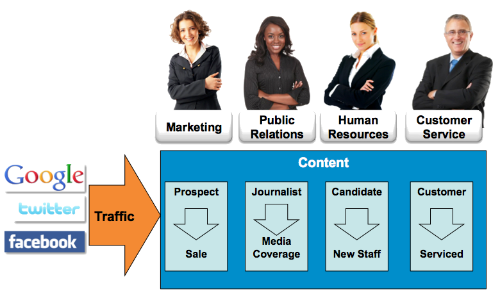
In past different departments within an organization were adhered to an organizational structure in a way that their activities did not involve a broad communication within the departments and the use of social media was mostly limited to marketing and public relations departments. However, now the reality is that social media permeates the entire organization and is becoming a part of organizational culture.
Let’s see how social media practices are embedded in different departments within a company.

Social media is the dominant form of communication in marketing department. Marketing practices are no longer limited to the traditional ways of media such as radio, TV, banners, magazines, cold calling, flyers, etc.
Printing press and radio ads and TV ads were the first forms of marketing tools and then came life magazines and telemarketing, Facebook, you tube, twitter and many others.
 There was an infographic about “Marketingpast, present and future” posted on (My Customer) that I found interesting to share here.  ( NATALIE BRANDWEINER Community Editor, 2013)

The growth of social media in 2000s to now has been the beginning of a new era in the field of marketing. Today marketers use different forms of social media such as tweeter, google+, face book, google panda, push notifications on smart phones, you tube and many other forms of social media for branding, customer service, marketing campaigns and brand awareness. The enhancement of social media has brought success in the areas of B2B (business to business) and B2C (business to consumers).
 Marketing needs to adjust its use of social media as the technology and social media improves. Therefore, the use of social medial in the field of marketing in future will grow as the social media grows.


Research & Development & Social media

Social media is a big facility in the department of Research & development for collecting competitive intelligence about the products and service of your company and those of competitors. It also helps R&D department to find out about the level of demand and people’s insights on different services and products. Research and development did not have as many facilities to communicate the results of a research or product development and to gather information for their research, while now it is a matter of a click. And as the social media grows, it will bring more facilities in the field of R&D in future.


Finance and Accounting & Social media

Social media is an important channel that offers faster way of delivering news, sharing information, asking for advise and consulting with other departments and management team on different issues for finance and accounting departments. Different departments within a company work together in delivering a service or a product and the ideas of every employee in every department have a bearing in the process of decision making. Social media definitely has made this easy on everyone within an organization and will bring better outcomes in future.


http://www.toprankblog.com/wp-content/uploads/2011/12/organizational-seo.png (organizational-seo)


Management/ executives & Social media

Social media is a great tool of communication for the management to stay connected with the rest of the staff and interact effectively and efficiently. Employer -employee communication is no longer limited to face to face meetings and phone calls or emails only. Today wikis, blogs, face book, to name a few, are commonly used by managers and executives. Building an online community around the organization has proven to be successful in most part for the management team. CEOs and managers can share news and information though use of social media. It helps the management build good relationships with the employees. It gives employees the chance to communicate directly with higher levels. It also helps management understand and be aware of what is happening inside the company and proactively manage some crisis within the company. According to a research from Weber Shandwick & KRC Research, 630 senior professionals were surveyed from around the world. 76% of executives think it is a good idea for CEOs to be social.  (Newsroom)


Loss prevention/ Security & Social media

Gathering more data and passing policies and procedures to the staff on security issues are some of the important tasks in the department of loss prevention/ security. A lot of companies now use social media such as face book or tweeter to post a photo or ask for witnesses’ help on cases of theft or other unethical business practices. And it seems to be a great facility for this department now and in the years to come.


Human Resources & Social media

As social media becomes more defined in the business world, human resources professionals will have a significant opportunity to leverage this powerful medium in many aspects of the business. HR is using social media in various functions related to labour relations, recruitment, talent management, policy management, etc.  Social media helps HR department with effective recruiting and it facilitates the process of training.  HR can also use social media to interact with employees and to gather information on certain job candidates. Facebook, linked in and blogs are the kinds of social media used mostly by HR team.
Social media profiles give a lot of information to recruiters nowadays and help them with their decision making. Here is an article on LIVE SCIENCE on "Using a social media profile as a résumé will be the new normal for hiring in 2014,"  (Nicole Fallon, 2014)

 I come to the conclusion that Social media is an integrated part of everyday life personally and professionally and it has brought a big facility in the way of communications and collaborations within a company and globally. Do you find it differernt at your work place?


Some facts about social media and workplace  (Kramer, 2011)


  •       According a recent Gartner Inc. report,50% of large organizations blocked employees access to social media in 2010  while  <30% will do this by 2014

  •      1/3 Americans use 3 devices for work and 7/10 friended their boss  or coworkers on Facebook.
  • Social media usage statistics: 71% of companies use Facebook, 59% use Twitter and 33% use YouTube. Only 6%use My Space.


  •  53% of employers search potential job candidates on social networks and one in three said that their profiles proved that they had lied on their CV.

·        

References

(

NATALIE BRANDWEINER Community Editor). (2013, 09 06). News . Retrieved from (MyCustomer.com): http://www.mycustomer.com/news/infographic-marketings-past-present-and-future

(2011, March 26). ODM Group. Retrieved from https://www.youtube.com/watch?v=ukA2zKGQClk
Curtis, D. A. (2013). The Brief History of Social Media. Retrieved from uncp.edu: http://www2.uncp.edu/home/acurtis/NewMedia/SocialMedia/SocialMediaHistory.html
Kramer, S. (2011, October 05). V3 integrated marketing. (V3 integrated marketing ) Retrieved from http://www.v3im.com/2011/10/how-fast-is-social-media-growing/#axzz2t7iM38Lf
Newsroom. (n.d.). Retrieved from Webersandwick.com: http://www.webershandwick.com/news/article/the-social-imperative-for-ceos
Nicole Fallon, B. C. (2014, January 12). Live Science. Retrieved from http://www.livescience.com/42512-social-media-new-resume.html
(Webershandwick.). Retrieved from http://www.webershandwick.com/uploads/news/files/Social-CEO-Study.pdf

(Currentware). Retrieved from currentware.com: http://www.currentware.com/wp-content/uploads/2013/03/social-media-at-work.jpg
(social evolution). Retrieved from http://www.agent-seo.com/wp-content/uploads/2012/01/social-evolution.jpg
(organizational-seo). Retrieved from http://www.toprankblog.com/wp-content/uploads/2011/12/organizational-seo.png